
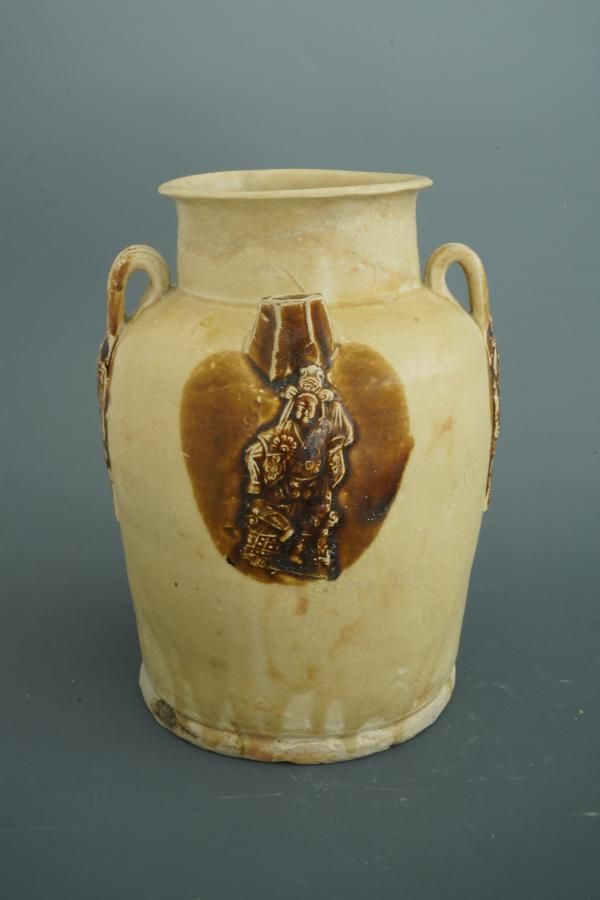
唐 长沙窑模印贴花舞蹈人物执壶
高23.5cm,口径 11.1cm,底径 15.2cm
卷沿,短粗颈、丰肩、直腹下收,肩上有一棱柱形短流,与流相对处为弓形鋬,两侧各有三根泥条并成的曲形系,在流和两系下方各饰一块胡旋舞者贴花。模印贴花是长沙窑常用装饰技法之一,通过模具印出纹样后粘贴在泥胎表面,罩上青釉,兴使贴花更为醒目,在贴花部位再涂以褐釉斑块,入窑烧制后,纹样醒目且有立体感。
Ewer with Moulded Appliqué Dancers, Changsha Kiln
Tang Dynasty (ca. 618–907 CE)
This ewer stands 23.5 cm high, with a mouth diameter of 11.1 cm and a base diameter of 15.2 cm.
It has a rolled rim, a short neck, a full shoulder, and a body that tapers downward. A short prismatic spout rises from the shoulder, opposite an arched handle. Curved lugs formed from joined clay strips are attached on both sides. Below the spout and lugs are moulded appliqué figures of dancers performing the Sogdian whirl. Moulded appliqué was a common decorative technique at Changsha kilns. Motifs were stamped in moulds, applied to the surface, and covered with glaze. Brown glaze was added over the appliqué areas before firing, producing bold and three-dimensional designs.
(英文翻译:王芳玲)